
Astaxanthin vs Canthaxanthin: Why One Is Safe and the Other Isn't

When it comes to tanning supplement ingredients, not all carotenoids are created equal. Astaxanthin and canthaxanthin are both pigments capable of altering skin tone, but the science, safety records, and regulatory history of these two compounds could not be more different. Understanding why matters before you put anything into your body.
What Are Carotenoids, and Why Do They Affect Skin Color?
Carotenoids are a class of naturally occurring pigments found in plants, algae, and certain fungi. When consumed by humans, some carotenoids deposit in subcutaneous tissue and can influence skin hue. This is the same principle behind why eating large quantities of carrots can temporarily tint skin orange.
In the supplement world, this property has been leveraged to create tanning supplements that aim to deepen or warm skin tone from the inside. Two carotenoids have historically been associated with this use: astaxanthin, canthaxanthin, and to a lesser extent lycopene. The astaxanthin canthaxanthin comparison is the most consequential from a safety standpoint. They look similar on paper, both are red-orange pigments in the carotenoid family, but their behavior in the human body is dramatically different.
Canthaxanthin: The Carotenoid the FDA Banned for Tanning Use
Canthaxanthin (also written as canthaxanthin astaxanthin comparisons frequently come up in scientific literature) was widely used in commercial tanning pills during the 1980s. It was marketed as a sunless tanning product long before the safety data caught up.
The problem, and it is a serious one: canthaxanthin deposits in the retina.
Studies published in peer-reviewed journals documented a condition called gold dust retinopathy, a form of crystal deposition in the retina caused by canthaxanthin accumulation. Research published in Survey of Ophthalmology (1993) catalogued cases of retinal crystalline deposits in users of canthaxanthin tanning products. These deposits can persist for years after stopping use and, in some cases, are associated with visual field disturbances.
The FDA responded decisively. Canthaxanthin is not approved for use as a tanning agent in the United States. While it is permitted in very small quantities as a food coloring additive (far below the doses used in tanning pills), products marketed specifically for skin-darkening via canthaxanthin have no FDA approval pathway for that purpose.
FDA Position on Canthaxanthin: The FDA has never approved canthaxanthin as a tanning agent. Tanning pills containing canthaxanthin as their active ingredient are considered illegal for that marketed use in the United States. The agency issued warnings against such products dating back to the late 1980s.
Beyond retinal concerns, high-dose canthaxanthin has been associated with aplastic anemia in rare cases and hepatotoxicity in animal studies. The risk profile at tanning-relevant doses is not acceptable by modern safety standards.

Meet ChUV
The tanning gummy the article is about.
One daily gummy. Warm, natural tone in weeks. No UV, no beta carotene, no gimmicks.
- Clinical doses of astaxanthin + lycopene
- Visible warmth by week 3-4, peak at week 8
- Vegan, non-GMO, made in the USA
Astaxanthin: A Different Compound Entirely
Astaxanthin is structurally related to canthaxanthin, both are keto-carotenoids, but their biological behavior in humans is profoundly different. The key differences begin with source and structure.
Natural astaxanthin is most commonly derived from Haematococcus pluvialis, a species of freshwater algae that accumulates astaxanthin under stress conditions. This algae-derived form has been the subject of extensive clinical research across the past three decades.
The critical distinction: astaxanthin does not deposit in the retina. Multiple studies, including research published in Molecular Nutrition and Food Research (2011) and Marine Drugs (2014), have examined astaxanthin's distribution and metabolism in human tissues. The compound is metabolized and cleared through normal pathways without the crystalline deposition observed with canthaxanthin.
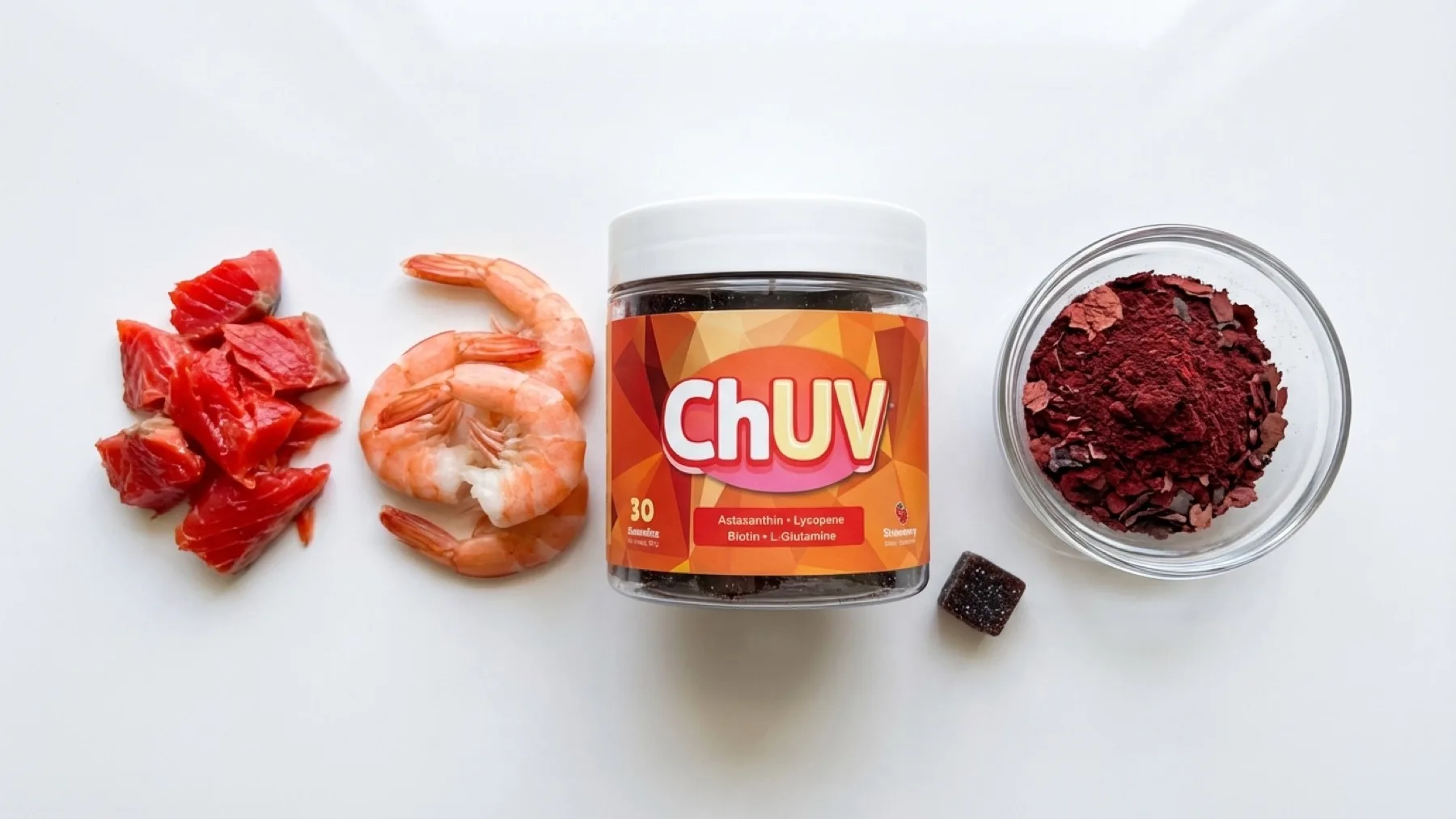
The Antioxidant Dimension: Why Astaxanthin Is Genuinely Remarkable
Beyond the safety contrast, astaxanthin stands out as a potent antioxidant with a body of evidence that canthaxanthin simply cannot match. Research published in Marine Drugs (2018) placed natural astaxanthin among the most powerful known antioxidants derived from natural sources, with activity significantly exceeding vitamin C, vitamin E, and most other carotenoids.
The mechanism involves oxidative stress reduction at the cellular level. Astaxanthin can span the entire cell membrane, providing antioxidant protection both inside and outside the cells, which most antioxidants cannot do. This unique molecular geometry, described in research published in Antioxidants (2022) by Fakhri et al., contributes to its superior protective capacity.
The antioxidant capacity data from research by Naguib (2000), published in Analytical Biochemistry, and cited extensively in subsequent PubMed literature, demonstrated that astaxanthin's singlet oxygen quenching activity is approximately 6,000 times stronger than vitamin C, 110 times stronger than vitamin E, and 10 times stronger than other carotenoids including beta-carotene.
| Property | Astaxanthin | Canthaxanthin |
|---|---|---|
| Primary source | Haematococcus pluvialis algae, natural fermentation | Synthetic production (most commercial); some natural sources |
| Retinal deposition | Not documented at supplement doses | Documented; gold dust retinopathy |
| FDA tanning use approval | GRAS status; not restricted for supplement use | Not approved as tanning agent; FDA warned against tanning pills |
| Antioxidant activity | Extremely high; unique membrane-spanning structure | Moderate; standard carotenoid activity |
| Oxidative stress reduction | Strong clinical evidence across multiple studies | Limited favorable data; risk concerns dominate literature |
| Health benefits data | Extensive: skin, eye, cardiovascular, anti-inflammatory | Limited; primarily studied for adverse effects |
| Safety classification | Generally recognized as safe (GRAS) at supplement doses | Not GRAS for tanning applications |
Astaxanthin GRAS Status and Regulatory Standing
The FDA's Generally Recognized as Safe designation is not automatic. It requires a documented history of safe use or scientific consensus on safety at intended use levels. Astaxanthin derived from Haematococcus pluvialis has received GRAS status for use in dietary supplements, reflecting the substantial body of safety data supporting its use.
This stands in direct contrast to canthaxanthin's regulatory history. A substance that accumulates in the retina, has been associated with aplastic anemia, and carries no approval for its primary marketed use is not a compound that can or should be normalized in consumer supplements.
Research by Ambati et al., published in Marine Drugs (2014), provides a comprehensive review of natural astaxanthin, astaxanthin from Haematococcus pluvialis, safety data, with et al. studies consistently showing favorable outcomes at doses used in dietary supplements. The authors note the compound's excellent tolerability across human clinical trials reviewed through that date.
Why ChUV Uses Astaxanthin, Not Canthaxanthin
The choice is straightforward when the evidence is laid out. ChUV tanning gummies use astaxanthin as the primary carotenoid because:
Why Astaxanthin is the Right Choice
Pros:
- GRAS status with documented safety at supplement doses
- No retinal deposition risk
- Powerful antioxidant activity that supports skin health broadly
- Extensive clinical research base
- Naturally derived from Haematococcus pluvialis algae
Not Canthaxanthin because:
- Retinal crystalline deposits (gold dust retinopathy) documented
- FDA has not approved it as a tanning agent
- Risk of aplastic anemia at tanning-relevant doses
- No GRAS designation for tanning supplement use
- Safety concerns outweigh any cosmetic benefit
ChUV pairs astaxanthin with lycopene (from tomato extract), another well-studied natural carotenoid with a strong safety profile, to support a warm, natural skin tone without the risks associated with synthetic or poorly-tolerated compounds. For more on the full ingredient science, see our breakdown of ChUV tanning gummies ingredients.
Frequently Asked Questions
Are tanning supplements with astaxanthin safe?
Yes, astaxanthin derived from Haematococcus pluvialis carries GRAS status and has been studied extensively in human clinical trials. At supplement doses, it does not accumulate in the retina and is metabolized through normal pathways. This distinguishes it clearly from canthaxanthin, which has documented retinal deposition risk.
Is canthaxanthin still used in any products today?
Canthaxanthin is permitted as a food coloring in very small quantities. However, products marketed as tanning pills using canthaxanthin as an active ingredient are considered illegal for that use in the United States. The FDA has issued specific warnings against such products.
What causes gold dust retinopathy?
Gold dust retinopathy results from crystalline deposits of canthaxanthin accumulating in the retina. These deposits appear as golden or yellow flecks visible on ophthalmoscopic examination. They can persist for years after canthaxanthin use is discontinued and may be associated with changes in visual field sensitivity.
Does astaxanthin have benefits beyond skin tanning?
Extensively, yes. The antioxidant activity of astaxanthin supports general skin health, has been studied for cardiovascular benefits, eye health protection, anti-inflammatory effects, and exercise recovery. These benefits come from its ability to neutralize free radicals across both membrane lipid layers and aqueous compartments simultaneously.
What is the difference between natural and synthetic astaxanthin?
Natural astaxanthin from Haematococcus pluvialis algae is the form used in dietary supplements and supported by most clinical research. Synthetic astaxanthin exists but is primarily used in aquaculture and does not carry the same safety data or GRAS status for human supplement use.
The Bottom Line on Safe Tanning Supplement Ingredients
The science is clear: canthaxanthin is a carotenoid with a documented history of harm at tanning doses and no FDA approval for that use. Astaxanthin from Haematococcus pluvialis is a naturally derived, GRAS-classified compound with an extensive record of safety and meaningful health benefits beyond skin appearance.
When you choose ChUV Tanning Gummies, you are choosing a supplement built on ingredients that have earned their safety credentials through rigorous research, not one that sidesteps those standards.
Have questions about ChUV's ingredients or want to learn more about what makes our formula different? Contact the CAYO Nutra team directly.
The Timeline
Watch the glow build.
Scrub through eight weeks on ChUV. Pigment saturation, biology, and the moment the shift becomes visible, week by week.
Serum carotenoid levels rising. Antioxidant activity active.
The carotenoids load.
Astaxanthin and lycopene enter systemic circulation and begin to deposit in dermal tissue. You will not see the shift yet. The biology is running underneath.
11mg
Astaxanthin daily
5.5mg
Lycopene daily
7days
Consistent dosing
The shift goes visible.
Dermal saturation reaches the threshold where warmth reads in natural light. Face, chest, and forearms register first. Subtle, not staged. Sun-kissed, never painted.
62%
Carotenoid saturation
2-3tones
Visible warmth gained
28days
Consistent dosing
Full steady state.
Even distribution across skin tissue, a warm baseline that holds as long as you stay on the daily dose. This is the ChUV finish line and the starting point of the maintenance phase.
96%
Carotenoid saturation
1gummy
To hold the tone
56days
Consistent dosing
Built around the clinical-study window. The shift is gradual on purpose: the color reads natural because it builds like a real tan.
4.8/5 from 2,300+ reviews
What customers actually say.
Questions, answered
FAQ
How long before I see results?
Most people notice a warm tone by week 3-4, with full results at 8 weeks on one gummy daily.
Do tanning gummies work?
Yes. Carotenoid pigmentation is a well-documented pathway. ChUV uses astaxanthin and lycopene, both clinically studied for skin coloration.
Will ChUV turn me orange?
No. ChUV uses astaxanthin and lycopene at measured doses for a natural warm tone. Beta carotene is the ingredient that causes orange discoloration, and we refuse to use it.
Does ChUV replace sunscreen?
Astaxanthin offers real internal photoprotection by neutralizing UV-induced free radicals at the cellular level. For prolonged outdoor exposure, pair ChUV with topical SPF. Think of them as complementary.
What if I don't tan?
You don't need the sun to tan with ChUV. Carotenoid pigmentation deposits astaxanthin and lycopene directly into dermal tissue, producing a warm tone without UV. Sun exposure makes the effect richer. Astaxanthin and lycopene are photoprotective antioxidants, so pairing ChUV with moderate sun yields a deeper, more saturated tan than either alone.
Is ChUV safe to take daily?
Yes. ChUV is made in a GMP-certified facility in the USA, contains no artificial dyes, and is formulated at doses supported by clinical literature.
Can I take ChUV with other supplements?
Generally yes. Astaxanthin and lycopene are fat-soluble, so take ChUV with a meal that contains some healthy fat for best absorption.
How is ChUV different from other tanning supplements?
Most tanning gummies rely on beta carotene, which produces an unnatural orange cast at supplement doses. ChUV stacks clinically-studied astaxanthin and lycopene for a natural warm tone.
Does ChUV contain allergens?
ChUV is vegan, non-GMO, gluten-free, and free of the major allergens. See the full supplement facts panel on the product page.
How does shipping work?
Subscriptions ship free. One-time orders ship at standard domestic rates. Orders leave our fulfillment facility within 1 to 2 business days.
When should I expect to see results?
Most people see a first noticeable warmth in weeks 3-4 and full tone expression by week 6-8. Carotenoid pigmentation is cumulative, so consistent daily use matters more than dose stacking.
Do I need to keep taking ChUV to keep my color?
Yes. Carotenoid accumulation is gradual, and so is the fade. Daily use keeps your tone consistent.
Ready to start?
One gummy a day. Four weeks to visible warmth.
Join thousands already building their glow with ChUV. Subscribe and save 10%, skip or cancel anytime.